The tallest tree in Lucca might seem like just a relatively young “little one,” compared to some of its species in its native country. In the United States, coast redwoods can exceed 100 metres in height and live for over 1,000 years. Hyperion, the world’s tallest tree, at approximately 116 metres, would easily tower over a small 33-storey skyscraper.
Italy’s monumental tree (cod: 34/E715/LU/09)
Scientific name: Sequoia sempervirens (D.Don) Endl.
Family: Cupressaceae
Estimated age: about 175 years old
Circumference at 1,30 m: 576 cm
Estimated height: 35,20 m
It is an evergreen tree native to the Pacific coast between California and Oregon. This species includes the tallest and longest-lived specimens on Earth. It was introduced to Italy around the mid-1800s.
LOOK OUT
…as you move along the paths, the perfect vantage point to observe the large lightning wound on the trunk, which is slowly healing.
Despite the massive trunks and impressive heights reached by coast redwoods their foliage is not particularly broad. The branches grow mainly downward but do not extend much, even at the bottom of the tree, so the overall crown resembles a narrow cylinder.
Drawing caption: The male reproductive organs (strobili) are present on the same tree together with the small female cones that, when ripe, open to release the seeds
Likely arriving from the grounds of “Villa Reale di Marlia”, this magnolia has been part of the Garden’s history for for almost the entirety of its existence.
With its venerable age, revealed by its majestic hollow trunk and sturdy, gnarled main branches, it continues to brighten the garden with its large, fragrant white flowers.
Historical sources relate that many magnolias once lined the Garden’s main avenue, and their cut green branches were sold as ornamental in Northern Europe.
Italy’s monumental tree (cod: 28/E715/LU/09)
Scientific name: Magnolia grandiflora L.
Family: Magnoliaceae
Estimated age: about 195 years old
circumference at 1,30 m: 425 cm
Estimated height: 15 m
It is an evergreen tree native to the river environments and floodplains of the southeastern United States. It was introduced to Italy in 1750 at the Botanical Garden of Padova.
LOOK
…closely AT at the pine cone-like structures: they are multiple fruits composed of numerous woody “frutticini” (fruitlets) that, when ripe, open, releasing red seeds attached to a filament.
TOUCH the leaves on the ground: they are stiff and smooth on the top.
When flowers were still rare on Earth, magnolias were among the few species to possess them.
The current species are very ancient, and even today their flowers are large and relatively primitive.
They are pollinated by beetles, that voraciously chew even the tissues of the reproductive structures and petals which, fortunately, are sturdy enough to withstand such a lack of gentleness.
Drawing caption: Multiple fruit called “folliceto”
On this side of the knoll, the spiral path that runs along it begins at a reproduction the garrigue, a semi-natural Mediterranean environment characterised by dwarf, cushion-shaped shrubs growing sparsely on arid, rocky soil, often burned and grazed. In summer, these environments have a scorched appearance, but in spring they turn into a true botanical paradise bursting with scents and colours.
LOOK AT
… the shrubs at the base of the panel: they are rich in aromatic oils. Just touch them lightly to capture their scent with your hand
The garrigue is home to many species of orchids. At the base of the knoll, the brownish serapis (Serapias neglecta), with its distinctive flowers, is common. Above what appears to be a large tongue, there is a helmetlike structure where pollinating insects find shelter during the coldest hours. Indeed, inside this cavity, the temperature is higher than outside.
Picture caption:
Cistus salviifolius (Salvia cistus)
Cistus creticus subsp. eriocephalus (Hairy Rockrose)
Satureja montana (Winter savory)
Serapias neglecta (Brownish serapis)
Iris lutescens (Dwarf iris)
Lilium bulbiferum subsp. croceum (Orange Lily)
Centranthus ruber (Red valerian)
The spiny spurge (Euphorbia spinosa) contains substances that are unpalatable to animals that feed on the plants.
A charming spiral path allows visitors to ascend and descend the knoll without ever having to retrace your steps, immersing yourself in an authentic glimpse of Mediterranean vegetation. The large, shady holm oaks, symbols of the evergreen forest, give way to the species of the Mediterranean scrub, a dense formation of dark-green shrubs. Mastic trees and strawberry trees (Arbustus unedo) grow at the summit, while phillyrea and fragrant myrtle grow along the slopes. Depending on the season, flowers and berries brighten the undergrowth with their colours.
LOOK AT
… what appear to be the butcher’s broom leaves (Ruscus aculeatus). The presence of small flowers, red berries or tiny scales reveals instead that they are modified, flattened branches called cladodes.
In the Mediterranean climate, hot and dry in summer, plants must limit the evaporation of water barely available in the arid soil. To combat water stress, species have developed common adaptations: their leaves often have a small surface area, contain essential oils, are leathery, and covered with waxes and cuticles or dense hairs to retain moisture.
Picture caption:
The silvery hairs on the underside of holm oak leaves are denser on those exposed to the sun, while they may be sparse or absent on those growing in the shade.
Quercus ilex (Holm Oak)
Pistacia lentiscus (Mastic tree)
Phillyrea angustifolia (Phillyrea)
Ruscus aculeatus (Butcher’s Broom)
Myrtus communis (Myrtle)
Juniperus communis (Common Juniper)
Helleborus viridis (Green hellebore)
Cyclamen hederifolium (Sowbread, Ivy-leaved Cyclamen)
Native to the East, camellias conquered 19th-century Europe and quickly became the centrepiece of the aristocratic gardens of the Lucca area. Among the many ornamental varieties, derived mainly from Camellia japonica, many were dedicated, during the Risorgimento, to patriotic ideals of the country and historical figures. The Garden preserves many ancient varieties, whose conservation is a priority for the Tuscany Region, as well as several botanical species, including the critically endangered white Grantham camellia (Camellia granthamiana), which grows wild only in a few forests of southern China.
SMELL
……the flowers without touching them. Beautiful, colourful, and with evocative names, only the so-called winter camellias can also boast a pleasant scent.
A precious tea infusion is obtained from the apical leaves or shoots of Camellia sinensis. The small production of Italian green tea in Sant’Andrea di Compito was started thanks to the seeds of a camellia cultivated in the Garden.
Captions:
Ancient variety with irregular double flowers. In cultivated varieties, humans selected the number of petals, colours and shapes of the flowers.
Camelia ‘Stella di Compito’
C. japonica ‘Stella di Compito’
Single flower
Camelia ‘Rubra Simplex’
C. japonica ‘Rubra simplex’
Semi-double ‘anemone-shaped’ flower
Camelia ‘Anemoniflora Alba’
C. japonica ‘Anemoniflora Alba’
Dedicated to the 16th-century mercenary captain who became a symbol of Risorgimento values
Camelia ‘Francesco Ferruccio’
C. japonica ‘Francesco Ferruccio’
Ancient variety with irregular variegated double flowers
Camelia ‘Stella Polare’
C. japonica ‘Stella Polare‘
The Botanical Garden’s prestige grew thanks to the work of its directors, physicians and botanists, who established a network of contacts and collaborations with distinguished Italian and foreign scientists, leaving behind valuable museum collections linked to education and the naturalistic exploration of the Lucca area. Over time, the spaces were redesigned to meet new and diverse needs.
The first heated greenhouse for succulent species and tropical rarities was built in 1826. Other important transformations followed, particularly under Cesare Bicchi, who directed the Garden from 1860 for nearly fifty years. The municipality of Lucca acquired ownership of the Garden in 1903.
LOOK OUT FOR
… the oval plaque that Bicchi dedicated to the founders and the directors who preceded him, and the one that tells that in 1843 the Garden hosted the Assembly of Italian Botanists.
The collections, research and the teaching activities declined after 1906, but starting in the 1970s, new acquisitions, studies, and adequate care restored the Garden as a leading institution in biodiversity conservation through local and national projects.
Captions:
Table of fungi commissioned by Puccinelli. The herbaria, the historic library collection, the xylotheque, and the other collections belong to the “Cesare Bicchi” Museum.
Benedetto Puccinelli, director from 1834 to 1850, compiled a flora of the Duchy of Lucca and initiated research on the fungi of the Lucca area.
Attilio Tassi, director from 1850 to 1860. The catalogues preserved in the library testify to the exchanges of plants and seeds with other botanical gardens.
Cesare Bicchi, director from 1860 to 1906, initiated a study on the grape varieties cultivated in the Lucca area.
Lucca played a leading role in a true “green revolution” thanks to Elisa Bonaparte Baciocchi, a supporter of numerous initiatives in the fields of agronomy, landscaping, and public green spaces. In 1814 she approved a project for a garden dedicated to traditional local medicinal plants. The fall of Napoleon, however, forced her to flee that same year.
Maria Luisa di Borbone distinguished herself for her reforms in public education and founded the current Botanical Garden as an integral part of the Royal Lyceum, Lucca’s new university dedicated to science.
The Garden’s first director, botany professor Paolo Volpi, began its landscaping works in 1820. The living collections were established with plants from the Villa Reale in Marlia, the Botanical Garden of Pisa, and nurseries from other countries.
LOOK OUT FOR
….the large Cedar of Lebanon that Volpi planted in 1822
The magnolias and camellias, that now characterise the gardens of the Lucca area, were first introduced at the Villa Reale, where Elisa created a prestigious landscape garden.
Aiming to make the city more beautiful and modern, she also initiated the transformation of the city walls into an urban park. This project was continued by the subsequent government of Maria Luisa.
Captions:
Elisa Bonaparte Baciocchi
Princess of Lucca and Piombino since 1805 to 1814
Maria Luisa Borbone
Duchess of Lucca from 1817 to 1824
Paolo Volpi, director from 1820 to 1833, established the scientific library that houses an antique book collection
The names of plants, The language of science is universal
Why Latin in a Japanese botany text?
In scientific language, even in countries that use different alphabets, all species are identified by a single name written in Latin, with familiar characters. This convention allows botanists, gardeners and enthusiasts from all over the world to refer to the same plant without misunderstanding or the need for translation. This universal language is due to Linnaeus, who in the second half of the 18th century introduced a simple and rigorous system for naming living beings.
LOOK OUT… among the species identification tags present in the Garden for a scientific name that you think best describes the plant.
The identity of a plant is expressed in two words: its scientific name, a Latin binomial written in italics. The first term indicates the genus, which may be common to several related species, such as durum wheat or emmer, both belonging to Triticum. The second term, known as the specific epithet, uniquely distinguishes a species; thus Triticum durum is durum wheat while Triticum dicoccum is emmer. Names often evoke characters, myths or characteristics of the plant, but, being in Latin, they are not easily understood by everyone!
Captions
Star magnolia – Magnolia stellata
Linnaeus dedicated the genus to the botanist Pierre Magnol and referred to the star-shaped form of the flowers with the term stellata (‘starry’).
Cedro Cedrus libani Citrus medica
The italian common name for both trees is cedar, but using the scientific name avoids any confusion.
In Species Plantarum Linnaeus identifies the species
family; 2 genus; 3 specific epithet; 4. author who named the species; 5. common name; 6. geographical origin.
Curiosity and power of observation help to grasp how intriguing this section, housing several collections is. The largest collection, the Hortus sanitatis, contains medicinal species native to Italy and other plants from faraway countries.
The most unexpected collection is the agrobiodiversity one, composed of vegetables of the Lucchesia (Lucca area), representing important genetic heritage, the result of a long process of diversification, but also basic ingredients of the traditional cuisine.
The area changes its face with the seasons, in fact with at the first cold weather, many potted tropical species are moved to the greenhouses.
Map of botanical school
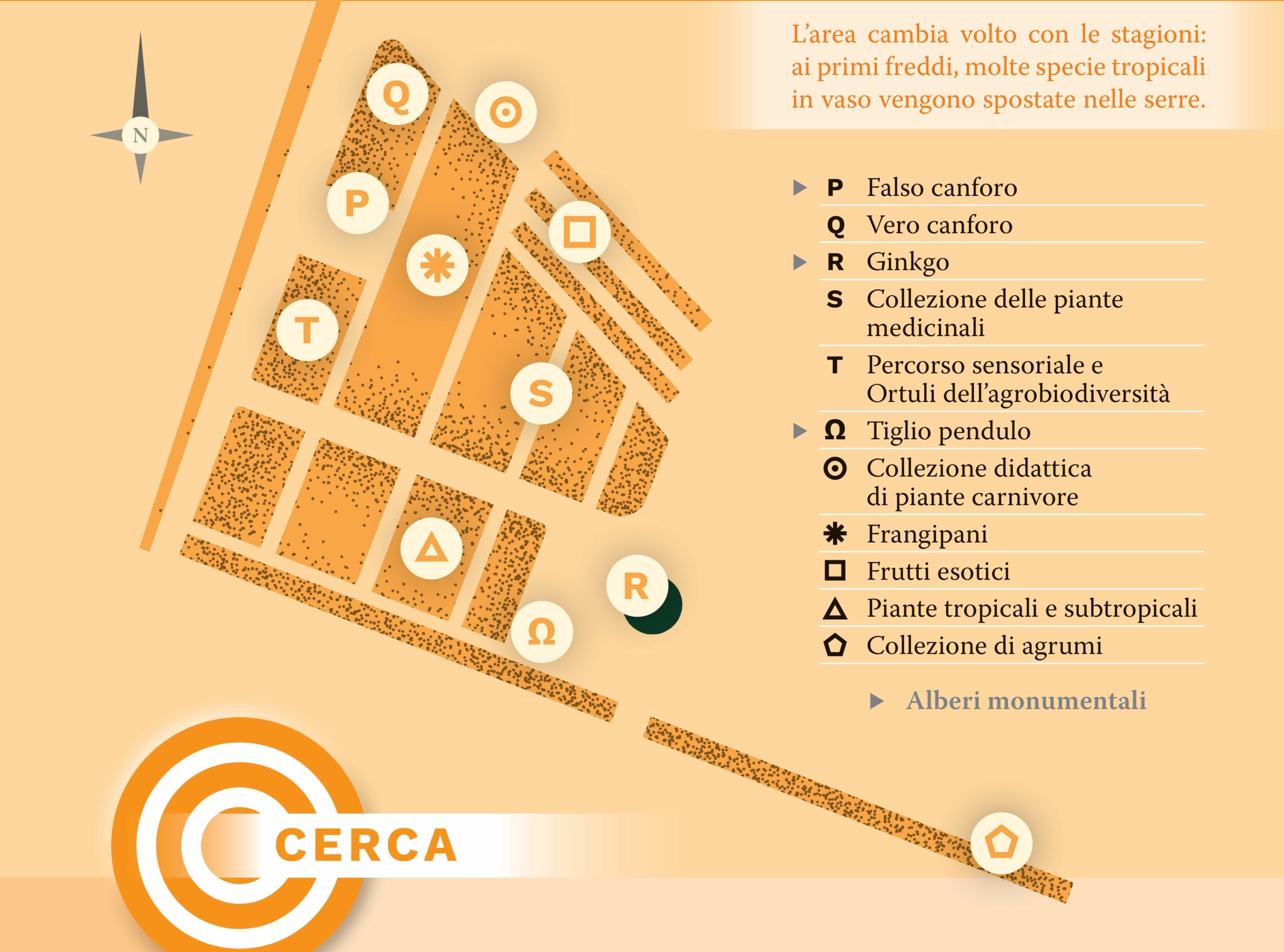
P Nepal camphor tree
Q Camphor tree
R Gingko
S Collection of medicinal plants / Hortus sanitatis
T Sensory Garden and Agrobiodiversity ‘Ortuli’
Ω Weeping silver lime
Ͼ Educational collection of carnivorous plants
* Frangipani
□ Exotic fruits
Δ Tropical and subtropical plants
⌂ Citrus collection
>Monumental trees
Photos
Deadly nightshade (Atropa belladonna)
Tree cotton (Gossypium arboreum)
Flat-leaved vanilla (Vanilla plantifolia)
Tomato (Solanum lycopersicum)
LOOK OUT FOR … the labels identifying large and small plants through their common names. You will find many friends from everyday life such as cooking or personal care. You will be able to identify through leaves and stems coffee, vanilla, cotton, foxgloves and many others.
The name of the area, ‘Botanical School’, dates back to its original function which, according to the tradition of botanical gardens, housed collections that were living examples of the various systems of plant classification, the most famous of which is the Linnaeus’one.
Beautiful, useful in medicine, capable of re-blooming even on cut branches, frangipani, or Pomelia, have conquered the world starting from Central and South America and the Caribbean.
In Mexico and Asia they are linked to spiritual rituals that are related to their medical proprieties and mechanical resistance. In Hawaii and Mauritius they have found a second homeland and their flowers are used to make the famous welcome necklaces.
The flower is the symbol of the city of Palermo (Sicily, Italy), and tradition states that a home pomelia flower is given by the mother to her daughter who gets married.
TOUCH
- The particular texture of the petals of the frangipani flowers that have fallen to the ground.
- Waxy, firm and strong enough to make…a necklace!
The plants of Plumeria genus arrived in Palermo in 1821 where it was love at first sight. Here they are called “pomelia”, but in the rest of Italy they are “frangipani”, probably in memory of Muzio Frangipane, the noble who created a famous fragrance very similar to that released by Plumeria rubra.